
Most backyard hardscape failures in Summerlin don’t happen because the material was cheap. They happen because it was picked for how it looked in a brochure instead of how it behaves at 115 degrees. Limestone that photographed beautifully in a Scottsdale catalog can spall and chalk within two summers here. Pavers laid over a base that never got compacted right will heave at the joints by July.
So here’s the promise: by the end of this piece you’ll know which four hardscape materials hold up in our specific heat and soil, which ones fight you, and the order to plan the project so you don’t pay twice. If you’d rather hand the whole thing to a crew that deals with this daily, a hardscape design company Summerlin can walk your actual yard before anyone commits to a paver. The material question still matters, though, so read on before you sign anything.
I’ve watched enough patios crack along their control joints to have opinions. Here they are, ranked by how well they survive a Summerlin summer.
Why Summerlin Chews Up the Wrong Materials
Three forces do the damage, and they work together.
The first is thermal cycling. Summerlin sits at higher elevation than the Strip, so days run hot and nights cool off fast. Concrete and stone expand and contract every single day. A slab that’s tied to a rigid edge with no room to move will crack at its weakest point, and it will do it in year one.
The second is caliche. That calcium carbonate layer under a lot of local soil is harder than some of the stone you’ll put on top of it. Dig it poorly and water pools against your base instead of draining away.
The third is the monsoon swing. Weeks of dry, then a storm dumps an inch in an hour. Drainage that looked fine in April becomes a riverbed in August. Materials set on a slope with nowhere to go will shift.
None of that is exotic. It just means the material choice and the base prep are one decision, not two. The hardest conversation I have with homeowners is the one where the stone is already ordered and the base is wrong.
Which Materials Hold Up in This Heat?
Four families earn their place in a Summerlin yard, and each one has a tradeoff you should know before you fall in love with a color.
- Concrete pavers. These are the workhorse. Individual units flex with the ground instead of fighting it, and if one cracks you lift it and swap it. Stick to pavers rated for freeze-thaw and heavy traffic, which the standards body ASTM International covers through its material specifications. Ask your contractor which spec the product meets. If they can’t answer, that tells you something. My pick for most families: a sand-set paver patio with a permeable joint, because it drains.
- Travertine. Genuinely cooler underfoot than concrete, which matters more than people expect in July. It’s porous, so it needs sealing, and unsealed travertine will grow a gray haze within a couple of seasons. Beautiful, but it asks for maintenance every year.
- Flagstone. Thick, heavy, and forgiving of an imperfect base as long as it’s set on a proper mortar bed or firmly on sand. The irregular shapes make it the best material for paths that follow a natural grade. It’s also the most expensive per square foot, so use it where you’ll actually walk.
- Poured concrete with a texture finish. The budget option, and it can work fine if it’s poured thick, cut with joints at regular intervals, and given a desert-friendly finish rather than a slick broom. Skip it if you want the patio to look like anything other than concrete.
| Material | Heat behavior | Maintenance | Best use |
|---|---|---|---|
| Concrete pavers | Stable, units flex with ground movement | Low, occasional re-sanding | Main patio, driveway apron |
| Travertine | Stays cooler underfoot | Annual sealing | Pool deck, seating areas |
| Flagstone | Very stable, handles grade changes | Low | Paths, steps, garden borders |
| Poured concrete | Cracks if joints are wrong | Low until it cracks | Utility areas, tight budgets |
The Base You Can’t See Decides Everything
It’s the part nobody photographs, and it’s the reason two patios with the same pavers can age completely differently. Under a Summerlin paver installation you should expect several inches of compacted aggregate base, compacted in lifts rather than dumped in one pass, with edge restraint that holds the field in place.
Here’s where I’d push back on a low bid. If the quote doesn’t mention base depth, compaction, or a drainage plan, the number is fiction. You’re comparing a full build against half of one. Ask to see the base before it’s covered. Good crews expect the question.
Water management belongs in this section too. The Environmental Protection Agency has long made the case for landscaping that absorbs rainfall where it lands, and that logic pays off in a desert yard during monsoon season. Slope every hard surface away from the house at a visible grade, and let water reach a planted area instead of your neighbor’s wall.
A Four-Step Plan Before You Buy a Single Paver
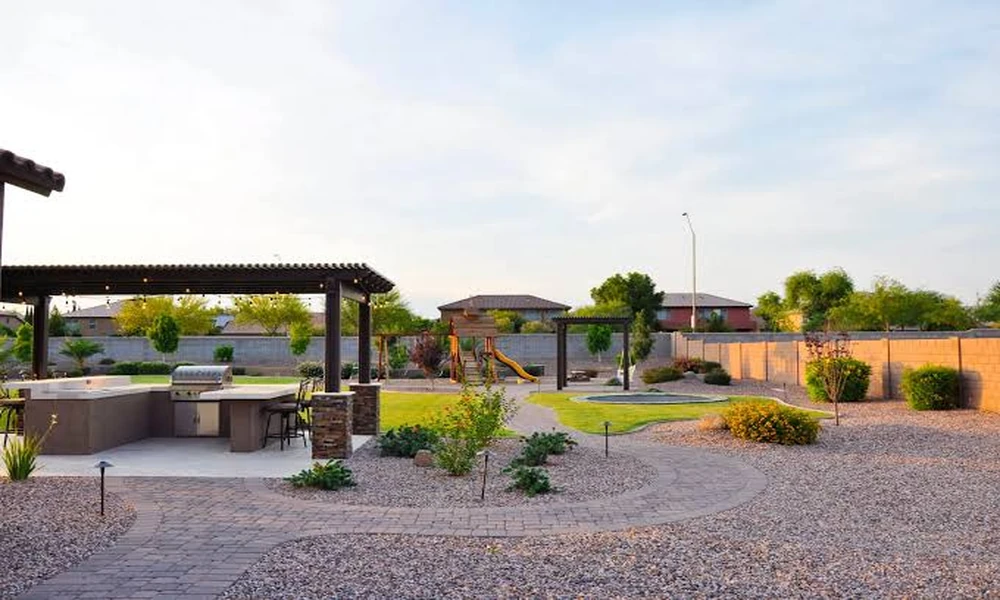
- Map the sun. Walk your yard at 9 a.m. and 4 p.m. in June. Mark the shaded pockets. Put seating there and hardscape elsewhere. You’ll use the yard twice as often.
- Decide shade before surface. A pergola or patio cover changes everything underneath it, including how hot the stone gets. Build the shade structure first on paper, then pick the material below it.
- Set your base spec in writing. Depth, compaction method, edge restraint, and where water exits. Get it in the contract, not the conversation.
- Budget for year five. Sealing, joint sand, and one repair. If travertine’s annual sealing sounds like a chore you’ll skip, choose pavers now and thank yourself later.
What About Stone Sourced Locally?
Worth a mention because it’s the quiet advantage of building in the Mojave. Stone quarried in the region has already proven it survives our climate, and shorter hauling distances keep the carbon and the cost lower. The National Park Service documents how the region’s native stone has held up in structures for generations, which is a decent durability test. If a supplier can tell you where the stone came from, that’s a good sign.
The Hardscape Decision That Actually Saves You Money
Cheap hardscape isn’t cheap. It just sends the bill to a later date, usually right after the warranty lapses. The money you save by choosing a thinner base or a slicker finish is money you’ll spend again on tear-out.
So my stance is simple. Spend on the base and the drainage, be moderate on the surface, and put the leftover budget into shade. Shade is the one upgrade that makes every other material feel better under your feet. A hardscape that stays put for twenty years costs less than two that fail in ten, and you get to enjoy the yard the whole time instead of watching a crack grow every spring.
What’s the one spot in your yard that gets unbearable by mid-afternoon? That’s your first project, and it’s probably smaller than you think. Get a crew to walk it with you before the summer rush, and ask them the base question directly. The answer will tell you everything.